Market
Rates Are Rising Again: What the Bank of Canada’s Hike Means for Commercial Real Estate
The Bank of Canada’s first rate hike in three years marks a turning point. For commercial real estate, it signals steadier, not cheaper, borrowing ahead.

Ardee Sharma
October 29, 2026 · 3 min read
Rates Are Rising Again: What the Bank of Canada's Hike Means for Commercial Real Estate
Oct 29, 2026 · @Ardee
Market · 3 min read
The Bank of Canada's first rate hike in three years marks a turning point. For commercial real estate, it signals steadier, not cheaper, borrowing ahead.
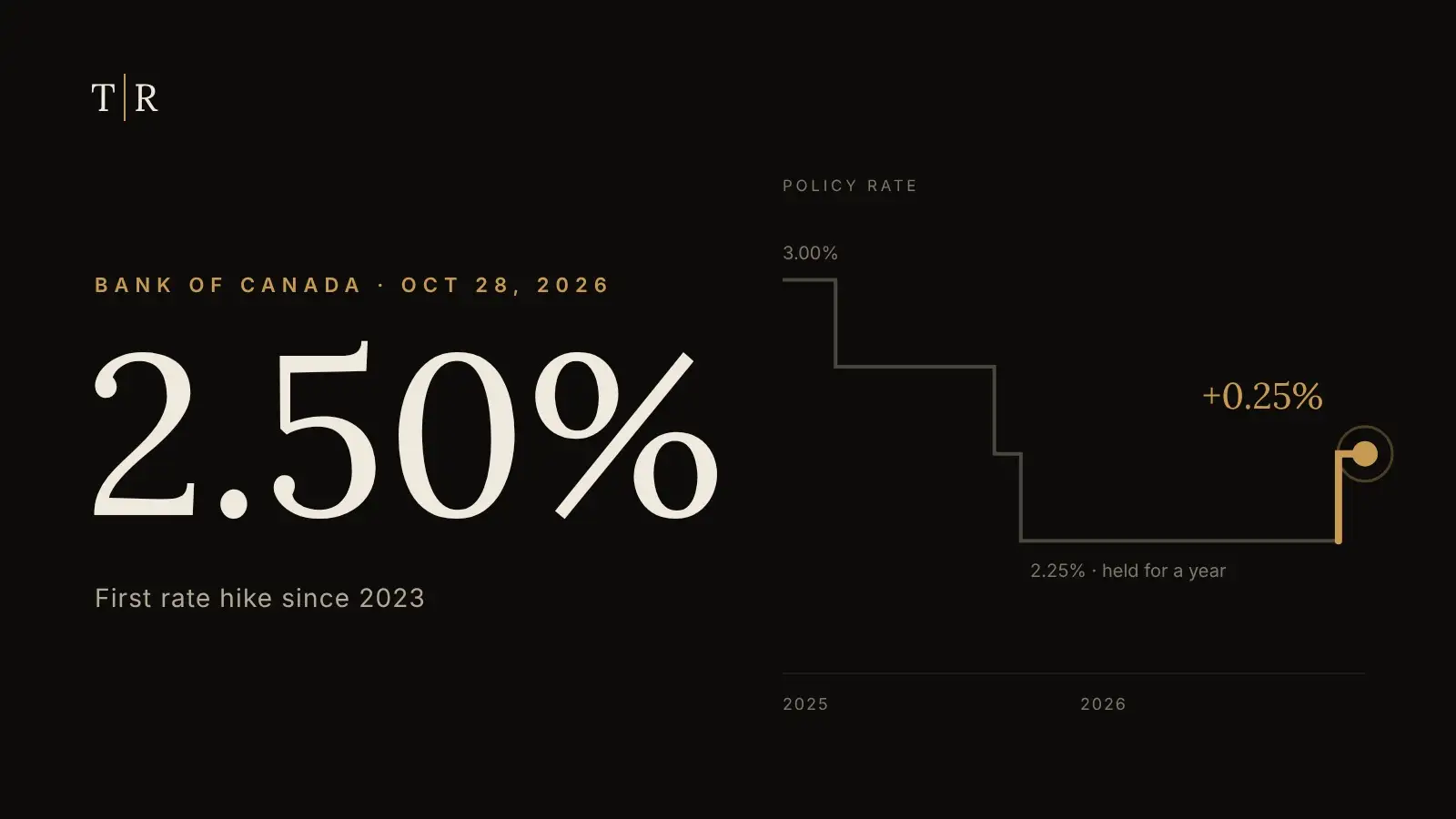
On October 28, the Bank of Canada raised its overnight rate by 25 basis points to 2.50 per cent. The move ends a year of holding steady and is the first increase since July 2023. Markets were not caught off guard, having priced in a roughly 80 per cent chance of a hike beforehand. Still, the decision changes the conversation for anyone buying, selling, financing or leasing commercial property in British Columbia.
Energy prices push the Bank off the sidelines
The hike is less about a hot economy and more about where prices are heading. Strip out gasoline and inflation sits close to the Bank's 2 per cent target. But higher energy costs are working their way into everyday prices, and both businesses and households expect that to continue.
The Bank now sees headline inflation climbing to about 3.5 per cent by year-end and averaging around 3 per cent through 2027. That is well above the 2 per cent it had pencilled in for next year just a few months ago. Governor Tiff Macklem was clear the door remains open: further increases could be needed, but the Bank intends to "proceed carefully."
Bond markets stay calm, but deal flow is slowing
The economy has held up better than expected. Growth ran at a 3.3 per cent annualized pace in the second quarter, and early estimates point to about 2 per cent in the third. The Bank expects 1 per cent growth for 2026 overall, improving to 2 per cent in 2027, with U.S. tariffs still a risk to that outlook.
For property owners, the most important signal came from the bond market. Five- and 10-year Government of Canada yields barely moved on the announcement. Those yields drive fixed-rate commercial mortgage pricing, so financing costs on new five- and 10-year terms have not jumped overnight. Industry forecasters expect two or possibly three more hikes over the next year, but at a far slower pace than the rapid-fire increases of 2022 and 2023.
The effect is already showing in transaction activity. Preliminary figures put national commercial investment at about $8.9 billion in the third quarter, down from just under $11 billion in the second. Buyers are taking longer to negotiate and underwriting more conservatively. Even so, activity remains roughly double its pandemic low, and much of the price adjustment from the last tightening cycle has already played out.
What this means for BC buyers, owners and tenants
The era of falling rates is over for now. The better news is that this cycle looks measured, and values have largely reset. Here is how we are advising clients across the Lower Mainland:
- Buyers: Fewer competing bidders and longer negotiations create room on price and terms. Lock in financing early and underwrite at today's rates, not hoped-for cuts.
- Owners with loans maturing: Review renewals now. Prime-based lines of credit and variable loans are already more expensive, while fixed terms are still priced off stable bond yields.
- Business owners who lease: Rising rents and steady long-term rates keep the lease-versus-own question worth revisiting, especially for owner-user strata and industrial space.
- Sellers: Pricing realistically matters more than ever. Well-located, well-leased assets continue to trade, but buyers are rewarding preparation and clean financials.
Thinking about buying, selling, refinancing or leasing commercial space in this market? Get in touch →